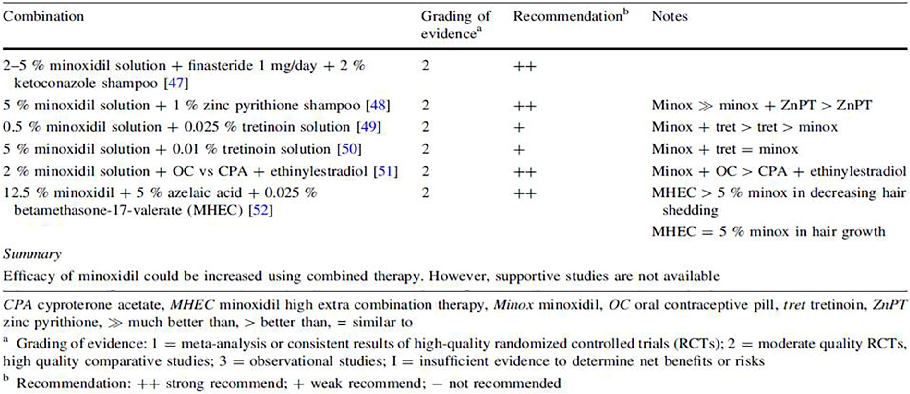
Description
A summary of clinical evidence supporting combination therapy with topical minoxidil for androgenetic alopecia in both men and women. The data, compiled by Varothai and Bergfeld (2014), indicates that multi-modal treatment approaches may offer improved outcomes compared to monotherapy.
More Figures from This Paper
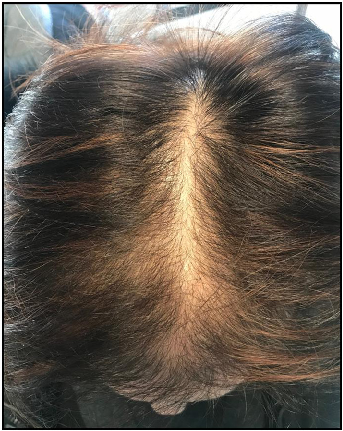
Figure 3
A clinical photograph demonstrating female pattern hair loss, showing characteristic diffuse thinning across the crown and mid-scalp. FPHL affects women with varying degrees of severity and may lead to significant psychological distress.
photograph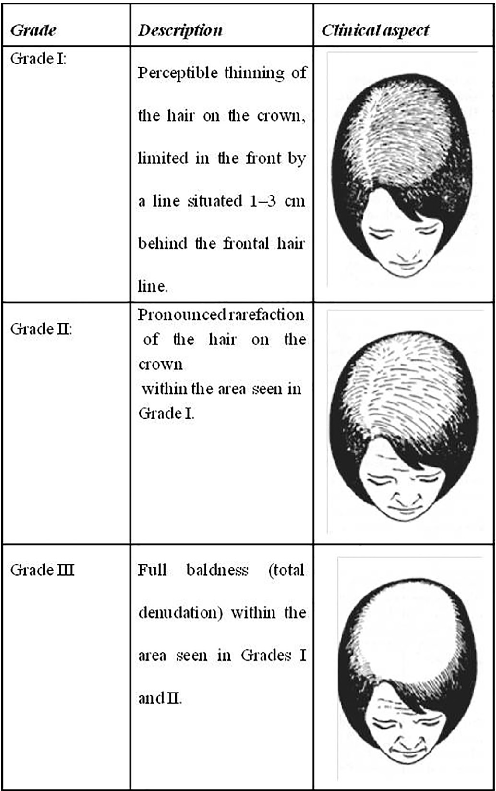
Figure 4
The Ludwig scale classifies female pattern hair loss into three progressive stages, ranging from minimal thinning at the crown (Grade I) to extensive hair loss across the top of the scalp (Grade III). This grading system remains one of the most widely used clinical tools for assessing FPHL severity.
diagram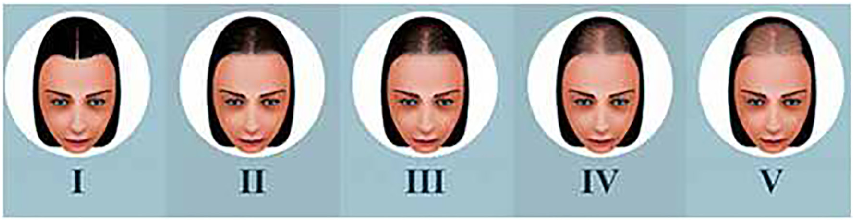
Figure 5
Sinclair's classification divides midline pattern alopecia into four intensity levels, progressing from a normal-appearing scalp to increasingly visible widening of the central part. The scale, introduced by Sinclair et al. (2005), provides a practical visual reference for clinicians assessing hair loss severity.
diagram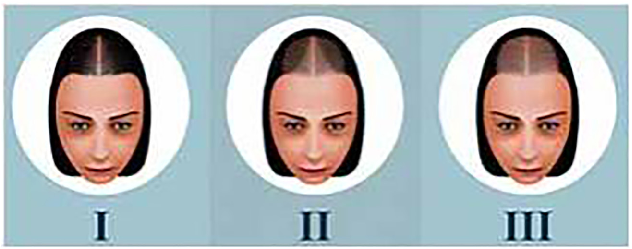
Figure 6
Olsen's classification system highlights the characteristic triangular or Christmas-tree pattern of frontovertical alopecia seen in female pattern hair loss. The accentuation of thinning at the frontal midline distinguishes this pattern from the more diffuse Ludwig classification.
diagramFigure 7
Source Paper
Female pattern hair loss: A clinical, pathophysiologic, and therapeutic review.Cite This Figure
 > Source: G Fabbrocini et al. "Female pattern hair loss: A clinical, pathophysiologic, and therapeutic review.." *International journal of women's dermatology*, 2018. PMID: [30627618](https://pubmed.ncbi.nlm.nih.gov/30627618/)
<figure>
  <img src="https://pdfs.citedhealth.com/figures/30627618/148.png" alt="A summary of clinical evidence supporting combination therapy with topical minoxidil for androgenetic alopecia in both men and women. The data, compiled by Varothai and Bergfeld (2014), indicates that multi-modal treatment approaches may offer improved outcomes compared to monotherapy." />
  <figcaption>Figure 7. A summary of clinical evidence supporting combination therapy with topical minoxidil for androgenetic alopecia in both men and women. The data, compiled by Varothai and Bergfeld (2014), indicates that multi-modal treatment approaches may offer improved outcomes compared to monotherapy.<br>  Source: G Fabbrocini et al. "Female pattern hair loss: A clinical, pathophysiologic, and therapeutic review.." <em>International journal of women's dermatology</em>, 2018. PMID: <a href="https://pubmed.ncbi.nlm.nih.gov/30627618/">30627618</a></figcaption>
</figure>
Related Evidence
Grade A · 299 studies
Grade A · 111 studies
Grade A · 206 studies
Grade A · 144 studies
Grade A · 45 studies
Grade A · 45 studies