The Efficacy and Safety of Oral Spironolactone in the Treatment of Female Pattern Hair Loss: A Systematic Review and Meta-Analysis.
Study Design
- Çalışma Türü
- Review
- Popülasyon
- None
- Müdahale
- The Efficacy and Safety of Oral Spironolactone in the Treatment of Female Pattern Hair Loss: A Systematic Review and Meta-Analysis. 56.60%
- Karşılaştırıcı
- None
- Birincil Sonuç
- hair growth/density
- Etki Yönü
- Mixed
- Yanlılık Riski
- Unclear
Abstract
Oral spironolactone has been proposed as a potential treatment for hair loss due to its antiandrogenic properties. However, the efficacy and safety of spironolactone for treating hair loss are not well-established. The objective of this study was to conduct a systematic review of the current literature on the use of oral spironolactone in female pattern hair loss. We conducted a systematic review and meta-analysis of randomized controlled trials and observational studies that assessed the efficacy and safety of oral spironolactone for treating hair loss. We searched for eligible papers in PubMed, Web of Science (ISI), Embase, and Scopus. All analyses were done using R software version 4.2.3 (R Foundation for Statistical Computing, Vienna, Austria). The overall rate of improved hair loss was 56.60%, with a higher rate of improvement (65.80%) observed in the combined therapy group compared to the monotherapy group (43.21%). However, there was significant heterogeneity in the efficacy outcomes, and hair loss did not improve or showed a modest improvement in 37.80% of all patients. The rates of adverse events reported in at least two studies were scalp pruritus or increased scurf (18.92%), menstrual disorders (11.85%), facial hypertrichosis (6.93%), and drug discontinuation (2.79%). The overall adverse events rate was 3.69%, but there was significant heterogeneity in the rates of different adverse events. In conclusion, the present study suggests that spironolactone is an effective and safe treatment option for hair loss. However, further research is needed to fully understand the heterogeneity of treatment response and adverse events and identify factors that may predict treatment response.
Kısaca
It is suggested that spironolactone is an effective and safe treatment option for hair loss, however, further research is needed to fully understand the heterogeneity of treatment response and adverse events and identify factors that may predict treatment response.
Full Text
Open Access Review Article DOI: 10.7759/cureus.43559
Review began 07/29/2023 Review ended 08/14/2023 Published 08/16/2023
© Copyright 2023 Aleissa. This is an open access article distributed under the terms of the Creative Commons Attribution License CC-BY 4.0., which permits unrestricted use, distribution, and reproduction in any medium, provided the original author and source are credited.
The Efficacy and Safety of Oral Spironolactone in the Treatment of Female Pattern Hair Loss: A Systematic Review and Meta-Analysis
1
Majed Aleissa
1. Department of Dermatology, King Abdulaziz Medical City Riyadh, Riyadh, SAU
Corresponding author: Majed Aleissa, [email protected]
Abstract
Oral spironolactone has been proposed as a potential treatment for hair loss due to its antiandrogenic properties. However, the efficacy and safety of spironolactone for treating hair loss are not well-established.
The objective of this study was to conduct a systematic review of the current literature on the use of oral spironolactone in female pattern hair loss.
We conducted a systematic review and meta-analysis of randomized controlled trials and observational studies that assessed the efficacy and safety of oral spironolactone for treating hair loss. We searched for eligible papers in PubMed, Web of Science (ISI), Embase, and Scopus. All analyses were done using R software version 4.2.3 (R Foundation for Statistical Computing, Vienna, Austria).
The overall rate of improved hair loss was 56.60%, with a higher rate of improvement (65.80%) observed in the combined therapy group compared to the monotherapy group (43.21%). However, there was significant heterogeneity in the efficacy outcomes, and hair loss did not improve or showed a modest improvement in 37.80% of all patients. The rates of adverse events reported in at least two studies were scalp pruritus or increased scurf (18.92%), menstrual disorders (11.85%), facial hypertrichosis (6.93%), and drug discontinuation (2.79%). The overall adverse events rate was 3.69%, but there was significant heterogeneity in the rates of different adverse events.
In conclusion, the present study suggests that spironolactone is an effective and safe treatment option for hair loss. However, further research is needed to fully understand the heterogeneity of treatment response and adverse events and identify factors that may predict treatment response.
Categories: Dermatology Keywords: safety, adverse effects, efficacy, spironolactone, androgenetic alopecia
Introduction And Background
Female pattern hair loss, also known as female androgenetic alopecia, is a common form of hair loss in women that affects up to 50% of women over the age of 50 [1]. The condition is characterized by a progressive thinning of hair on the scalp, typically in a diffuse pattern, and can result in significant psychological distress and reduced quality of life for affected individuals [2, 3].
Currently, there are limited effective treatment options for female pattern hair loss, and many of the available treatments, such as topical minoxidil and oral finasteride, have limitations in terms of efficacy, tolerability, and safety [1]. This has led to increasing interest in the potential role of spironolactone, an aldosterone antagonist with antiandrogenic effects, in the management of female pattern hair loss.
Spironolactone is a medication commonly used in the treatment of hypertension and heart failure, but it has also been shown to have antiandrogenic effects, which may be beneficial in the treatment of female pattern hair loss [4]. The antiandrogenic effects of spironolactone are believed to be mediated through its ability to inhibit the binding of dihydrotestosterone (DHT) to androgen receptors, thus reducing the production of sebum and the miniaturization of hair follicles [4]. Several studies have investigated the use of spironolactone in the treatment of female pattern hair loss, with promising results. Spironolactone was effective in improving hair density and reducing hair loss in women with female pattern hair loss, with no significant adverse effects reported [5, 6].
In this paper, we will conduct a systematic review of the current literature on the use of oral spironolactone in female pattern hair loss, including its efficacy and potential side effects. We hope that this review will provide a comprehensive analysis of the existing evidence on the use of spironolactone in female pattern hair loss and help guide future studies in this area.
How to cite this article Aleissa M (August 16, 2023) The Efficacy and Safety of Oral Spironolactone in the Treatment of Female Pattern Hair Loss: A Systematic Review and Meta-Analysis. Cureus 15(8): e43559. DOI 10.7759/cureus.43559
Review
Methods
Search Strategy and Study Selection
We followed the recommendations of the Preferred Reporting Items for Systematic Reviews and MetaAnalyses (PRISMA) and MOOSE (Meta-analyses Of Observational Studies in Epidemiology) checklists for conducting systematic reviews and meta-analyses. On March 26, 2023, we searched for eligible papers in PubMed, Web of Science, Embase, and Scopus. We tailored the search strategy based on each database; the detailed strategy is provided in Appendix 1.
Study selection was made using the PICO (population, intervention, control, and outcomes) framework: participants were patients with established androgenic alopecia diagnosis in females, and the intervention was oral spironolactone. The primary efficacy outcome was the rate of improved hair loss, while the secondary outcomes were the rates of no improvement or modest improvement and hair loss worsening. The primary safety outcome was the rate of adverse events associated with spironolactone treatment. We included all original studies satisfying the pre-defined criteria. We excluded non-English papers, studies using topical spironolactone, animal studies, non-original studies, case reports, and case series with less than ten patients. The screening was done in two stages - title and abstract screening, followed by a full-text one. Both stages were done by two reviewers, with the third one resolving any conflicts.
Two authors used the pre-designed Excel sheet (Microsoft Corporation, Redmond, USA) to extract all relevant data points, with the senior author doing quality control or resolving any disputes. The combined therapy was defined as the use of oral spironolactone and minoxidil, while the monotherapy was defined as using oral spironolactone alone, regardless of the dose used. The risk of bias was assessed by two reviewers using the Newcastle-Ottawa scale for the assessment of the quality of nonrandomized studies [7] and used the revised tool for assessing the risk of bias in randomized trials for randomized controlled trials (RCTs) [8]. In case of any disagreements, a third senior author would resolve them.
Statistical Analysis
All outcomes reported in at least two studies were included in the meta-analysis. We calculated prevalence rates and their corresponding 95% confidence intervals (CI) using the generalized linear mixed models with the logit link. The random-effects model was employed to pool the data due to methodological differences violating the common-effects assumption. Heterogeneity was assessed using the Q statistic and I2 test, where I2>50% or P-value <0.05 was considered significant. For the worsening of hair loss outcome, we used double arcsine transformation due to the presence of two zero events [9]. Publication bias using funnel plots was not possible due to the small number of included studies (<10) [10,11]. All analyses were done using R software version 4.2.3 (R Foundation for Statistical Computing, Vienna, Austra).
Search results
We initially retrieved 452 records, of which 207 were duplicates, to end up with 245 studies for the title and abstract screening. After excluding 231 studies in the first screening stage, 14 papers passed to full-text screening, to end up finally with five studies [5,12-15]. The search and screening process is summarized in Figure 1.
FIGURE 1: PRISMA flow diagram of the study process
PRISMA: Preferred Reporting Items for Systematic Reviews and Meta-Analyses
Study characteristics and risk of bias
The included studies have variable study designs such as prospective, retrospective, survey study, RCT, and a large case series. The number of patients ranged from 19 to 115, and the age ranged from 12 to 88 years in the included studies. The shortest treatment duration was six months, and the longest was over a year. The dosing regimen and treatments used were also variable across studies (Table 1). The risk of bias assessment results are summarized in the supplementary tables given in Appendix 2.
- TABLE 1: Summary of the included studies SPT: spironolactone; MX: topical minoxidil, FPHL: female pattern hair loss
Efficacy and safety
Four studies of 192 patients assessed changes in hair loss following oral spironolactone treatment. The overall rate of improved hair loss was 56.60% (95% CI=40.49-71.43), 65.80% (95% CI=43.75-82.63) in the combined therapy, and 43.21% (95%CI=32.90-54.15) in the monotherapy. One study used the Women’s Alopecia Severity index [15], the Sinclair grading score in three [5, 13, 14], and the Ludwig scale and the midscalp clinical grading scale in one [12]. However, there was a significant overall heterogeneity (I2=75%; Pvalue=0.003), and monotherapy and the combined therapy subgroup (I2=81%; P-value=0.005) (Figure 2).
FIGURE 2: The overall rate of improved hair loss
[12-15]
FIGURE 3: Subgroup analysis of the overall rate of improved hair loss
[12-15]
Hair loss worsened in 3.64% (95% CI=0.16-9.90) of all treated patients, in 3.45% (95% CI=0.01-10.37) of those on combined therapy, and in 3.97% (95% CI=0.00-23.81) of those on monotherapy. Heterogeneity was significant in the overall estimate (I2=64%; P-value=0.025) and within the monotherapy subgroup (I2=86%; P-value=0.007). In all efficacy outcomes, the rates were comparable between combined therapy and monotherapy groups.
For adverse events reported in at least two studies, scalp pruritis or increased scurf were the most frequently encountered at 18.92% (95% CI=11.54-29.45), followed by menstrual disorders, facial hypertrichosis, and drug discontinuation with 11.85% (95% CI=1.23-59.17), 6.93% (95% CI=2.86-15.84), and 2.79% (95% CI=1.176.53), respectively. The overall adverse events rate was 3.69% (95% CI=1.70-7.83); however, there was significant heterogeneity in the rates of different adverse events (I2=81%; P-value<0.001) (Figure 4).
FIGURE 4: Prevalence of adverse events
[12-15]
Discussion
Our systematic review and meta-analysis of available evidence aimed to evaluate the efficacy and safety of oral spironolactone for treating hair loss. The results of this study suggest that oral spironolactone may be an effective treatment for hair loss, especially when combined with other therapies. However, the significant heterogeneity observed in the efficacy outcomes indicates that the treatment response may vary across individuals. The rates of adverse events reported in this study are consistent with previous reports, and the overall adverse events rate is low. The most frequently encountered adverse event was scalp pruritus or increased scurf, which is a minor and manageable side effect. Menstrual disorders, facial hypertrichosis, and drug discontinuation were also reported in some studies. The overall adverse events rate was 3.69%, but there was significant heterogeneity in the rates of different adverse events. These findings suggest that spironolactone treatment may carry a risk of adverse events and should be used with caution, especially in patients with a history of menstrual disorders or other hormonal imbalances.
The results of this study are consistent with previous literature. A previous systematic review reported that spironolactone was effective in reducing hair loss in women with androgenetic alopecia [16]. In previous research conducted by Burns [14] and Sinclair [13], the efficacy of spironolactone in treating androgenetic alopecia was found to be significantly better with a 12-month treatment compared to a 6-month treatment.
Many other studies and case reports have also reported better efficacy of this combined therapy for androgenetic alopecia. For example, a 53-year-old woman with diagnosed androgenetic alopecia was successfully treated with a combination of daily spironolactone and topical minoxidil, which had an additive effect on hair regrowth [17]. Furthermore, in a similar case series of six adolescents found an evident improvement in five of them using the combination of oral minoxidil and spironolactone [18].
Limitations of this meta-analysis include the small sample size (413 patients) and the significant heterogeneity observed in the efficacy outcomes and adverse event rates. In addition, the heterogeneity in study designs, dosing regimen, duration, and how other agents are combined would limit the generalizability of the findings. Further studies with larger sample sizes and more rigorous study designs are needed to confirm these findings and determine the optimal dosing and duration of oral spironolactone treatment for hair loss.
Conclusions
Oral spironolactone may be an effective and safe treatment for hair loss, especially when combined with other therapies. Clinicians should consider the potential benefits and risks of this treatment option when managing patients with hair loss. Despite the promising results, there is still a need for further research to establish the optimal dosing regimens and treatment duration for spironolactone in female pattern hair loss with determining the safety and tolerability of spironolactone in this population.
Appendices
- Appendix 1: search strategy PubMed
- Appendix 2: supplementary tables
- TABLE 2: Risk of bias of non-RCTs assessed by the Newcastle-Ottawa Scale RCT: randomized controlled trial; NOS: Newcastle-Ottawa Scale
- TABLE 3: Risk of bias of RCTs assessed by Cochrane Collaboration’s risk of bias assessment tool RCT: randomized controlled trial
Additional Information
Figures
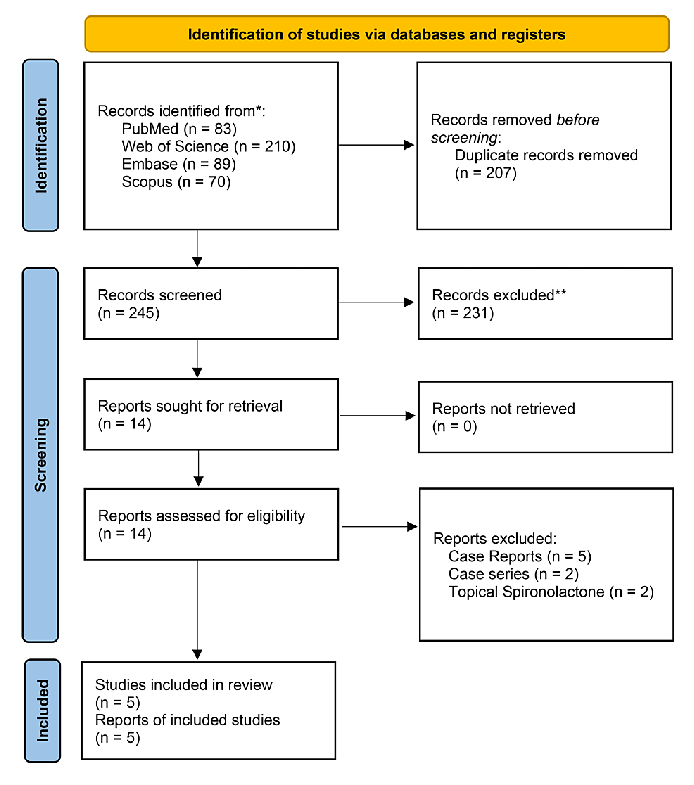
Figure 2
Forest plot or pooled analysis from the spironolactone meta-analysis, presenting combined efficacy data across studies examining oral spironolactone for treating female pattern hair loss.
forest_plot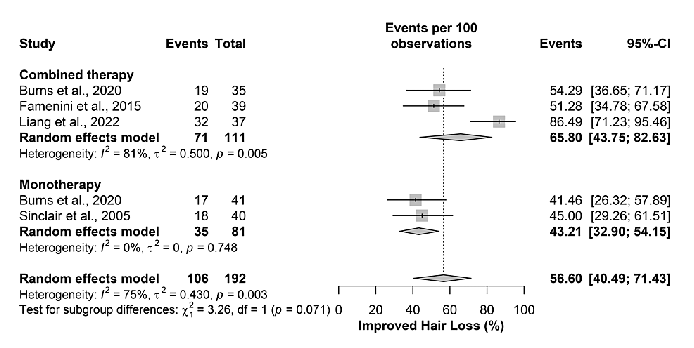
Figure 3
Risk of bias or quality assessment for studies included in the spironolactone and female pattern hair loss meta-analysis, evaluating methodological rigor across the evidence base.
chart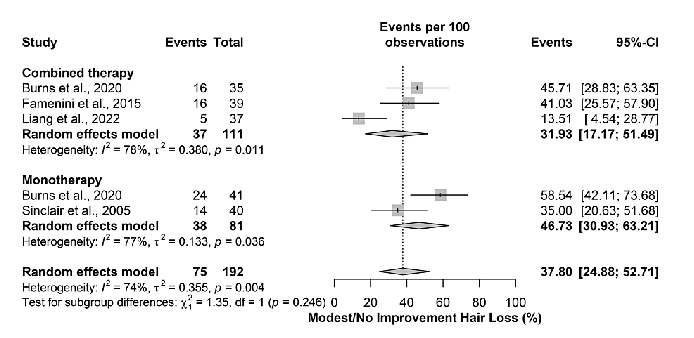
Figure 4
Pooled analysis indicating that hair loss did not improve or showed only modest improvement in 37.80% (95% CI: 24.88-52.71%) of patients treated with oral spironolactone, with subgroup analyses revealing variable response rates.
forest_plot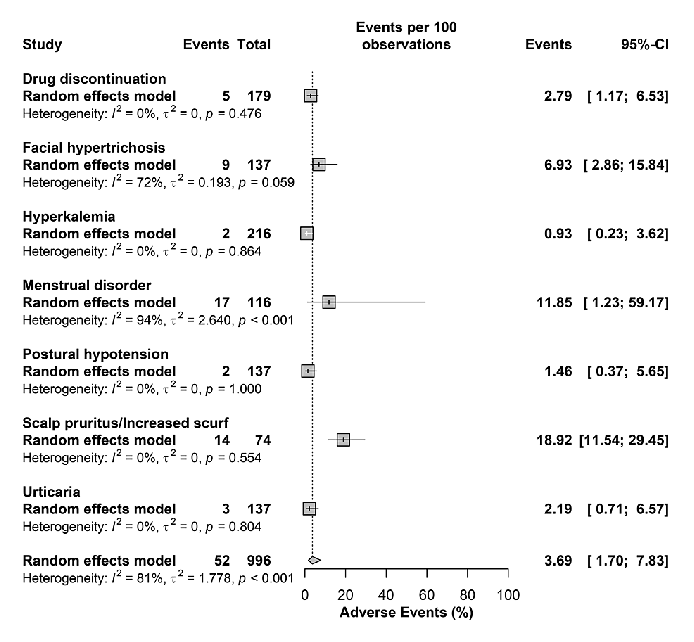
Figure 5
Safety outcomes or adverse event analysis from the spironolactone meta-analysis, summarizing the tolerability profile of oral spironolactone when used for female pattern hair loss.
chartUsed In Evidence Reviews
Similar Papers
Journal of the American Academy of Dermatology · 2005
Evaluation and treatment of male and female pattern hair loss.
The British journal of dermatology · 2005
Treatment of female pattern hair loss with oral antiandrogens.
International journal of dermatology · 2018
Female pattern hair loss: a pilot study investigating combination therapy with low-dose oral minoxidil and spironolactone.
International journal of women's dermatology · 2018
Female pattern hair loss: A clinical, pathophysiologic, and therapeutic review.
Dermatologic clinics · 1998
Hair regrowth. Therapeutic agents.
International journal of nanomedicine · 2014