Figure 6
1080 × 452px
· 87,2 KB
Source Paper
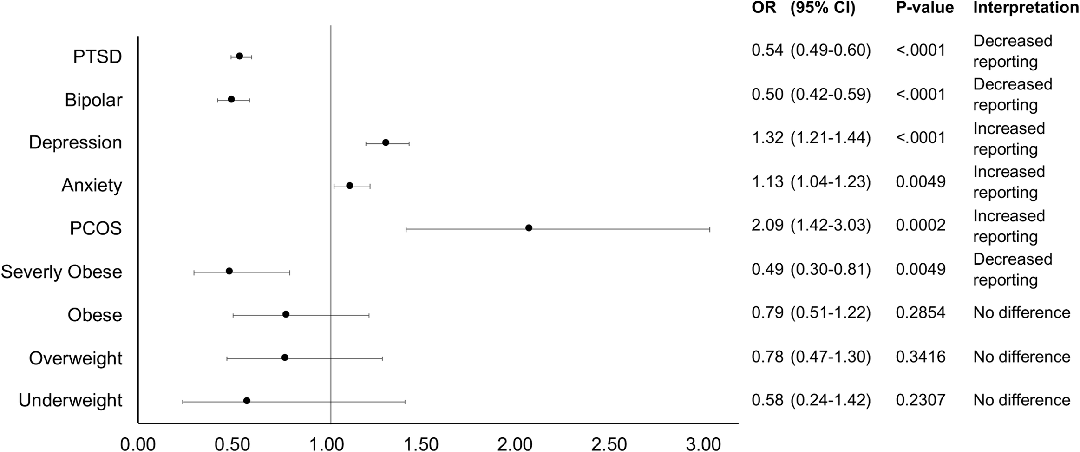
Epidemiological landscape of androgenetic alopecia in the US: An All of Us cross-sectional study.Cite This Figure
 > Source: Aditya K Gupta et al. "Epidemiological landscape of androgenetic alopecia in the US: An All of Us cross." *PloS one*, 2025. PMID: [40014580](https://pubmed.ncbi.nlm.nih.gov/40014580/)
<figure>
  <img src="https://pdfs.citedhealth.com/figures/40014580/244.png" alt="Fig 4. Likelihood of AGA reporting for females by comorbid condition. All data is represented as odds ratios of the condition compared to control with corresponding p-value and interpretation." />
  <figcaption>Figure 6. Fig 4. Likelihood of AGA reporting for females by comorbid condition. All data is represented as odds ratios of the condition compared to control with corresponding p-value and interpretation.<br>  Source: Aditya K Gupta et al. "Epidemiological landscape of androgenetic alopecia in the US: An All of Us cross." <em>PloS one</em>, 2025. PMID: <a href="https://pubmed.ncbi.nlm.nih.gov/40014580/">40014580</a></figcaption>
</figure>